Skip to content

Marc Lee Shannon Live in Concert | Wed. Nov. 19th

  • Online Recovery
    • Quit Opioids
    • Suboxone
    • Insurance or self-pay
    • At-home drug screenings
    • Quit Kratom
    • Medication assistance
    • Insurance or self-pay
    • Whole-person care (anxiety, insomnia, etc.)
    • Quit Drinking
    • Campral
    • Naltrexone
    • Insurance or self-pay
    • 100% Online
    • Non-judgmental providers
    • Help with co-occurring disorders​
    • Recovery groups
    • Real people (No AI bots)
  • About Us
    • Our Research

    Advancing substance use treatment through rigorous, peer-reviewed research and actionable insights.

    • Our Mission

    Everyone deserves access to the gold standard of treatment, without judgment.

    • Growing Our Team

    Join us in transforming addiction treatment and improving lives through digital care.

    • Founded and operated by people in recovery since 2015
  • Resources
    • Workit Health
    • Insurance checker
    • Locations
    • Reviews
    • Articles
    • Member stories
    • Opioid addiction help
    • Suboxone Basics
    • Quit drinking
    • Naltrexone basics
    • For friends and family
    • Resources
    • Help a loved one with addiction
    • Mental health apps
    • Helplines and support
    • Community in recovery
    • Medication resources
    • 32k+ App store reviews
    • 35k+ Members
    • 33% Referred by friends or family
  • Partners
  • Make A Referral
Book now
Book now
Book now
Login
  • Quit Opioids
  • Suboxone
  • Insurance or self-pay
  • At home drug screenings
  • Quit Kratom
  • Medication assistance
  • Insurance or self-pay
  • Whole-person care (anxiety, insomnia,etc.)
  • Quit Drinking
  • Medication assistance
  • Insurance or self-pay
  • Recovery groups
  • 100% Online
  • Non-judgmental providers
  • 35k+ Members
  • 3.2k+ Reviews
About Us
  • Our Research
  • Our Mission
  • Growing Our Team
Resources
  • Workit Health
  • Insurance checker
  • Locations
  • Reviews
  • Articles
  • Member stories
  • Opioid addiction help
  • Suboxone Basics
  • Quit drinking
  • Naltrexone basics
  • For friends and family
  • Resources
  • Help a loved one with addiction
  • Mental health apps
  • Helplines and support
  • Community in recovery
  • Medication resources
  • Partners
  • Make A Referral
  • Culture
  • LGBT+

A Brief History of the LGBTQIA+ Movement

  • Fact Checked and Peer Reviewed
  • By Olivia Pennelle

A future free of addiction is in your hands

Recover from addiction at home with medication, community, and support—from the nonjudmental experts who really care.

Get started today

What's your goal?

Join the 35k+ members who treated addiction via their phone

A person's feet in brown hiking boots, standing in the snow.

Alone On Christmas: How To Cope If You Aren’t With Family Or Friends This Year

Kali Lux
New Mexico in the sunset

How to Find Drug Addiction Help in New Mexico

Alaine Sepulveda
Snowy mountain peaks beneath a clear blue sky.

Why Try Dry January?

Alaine Sepulveda

In this article

Key Historical Facts of the LGBTQIA+ Movement 

Perhaps one of the most epic social movements of our time, the LGBTQIA+ rights movement has demonstrated the fearless activism of people fighting for civil rights. Their activism not only emancipated those identifying as gay or lesbian, but also paved the way for critical movements that form the foundation of the recovery movement, such as harm reduction. 

In this blog, we’ve provided a bird’s-eye view of the key historical events in the LGBTQIA+ movement, which can be categorized into 5 main areas:

  1. The Enlightenment Era
  2. Emergence of the LGBT Movement
  3. The Homophile Movement
  4. The Gay Liberation Movement
  5. LGBTQ+ Rights Movement

We’ve listed some important historical features of each era. Of course, this is really a snapshot of what has been a momentous civil rights movement for people who identify within the LGBTQIA+ spectrum. We cannot include every single moment, but have aimed to include as many as possible. 

Enlightenment Era

The enlightenment era spanned the 18th century, a time when same-sex conduct was considered socially unacceptable. However, “cross dressing” was considered acceptable within plays, such as in William Shakespeare.

We can date gay rights activism back to this era with a couple of notable events:

  • 1749: Thomas Cannon published the first defense of same-sex relationships, in Ancient and Modern Pederasty Investigated and Exemplify’d
  • 1785: Jeremy Bentham sought law reform that at the time punished acts of “homosexuality” with death

Emergence of the LGBT Movement

In the late nineteenth and early twentieth centuries, social attitudes towards “homosexuality” grew more hostile and were increasingly criminalized. Key events during this era include:

  • 1885: the Labouchere Amendment criminalized same-sex conduct among males and was used to convict Oscar Wilde in 1895
  • 1924: Henry Gerber created the Society for Human Rights in Chicago. 
  • 1928: English poet Radclyffe Hall published lesbian-themed novel, The Well of Loneliness.
  • 1938: Gay prisoners of war were labeled with pink triangles in Germany and sentenced to concentration camps

Homophile Movement (1945-1969)

Great political activism for the LGBTQ community began during the homophile movement that arose between 1945 and 1969. “Homophile” was a term coined by a splinter group formed from the Mattachine Society. It was used as a rejection of the term “homosexual,” which they believed pathologized or medicalized same-sex relationships. Homophile was chosen to express the notion of same-sex (homo) love (philia).

Key events during this era include:

  • 1948: Alfred Kinsey published Sexual Behavior in the Human Male
  • 1947-1957: The Lavender Scare, an anti-LGBTQ movement
  • 1951: Harry Hay Founded the Mattachine Society
  • 1955: Del Martin & Phyllis Lyon formed the Daughters of Bilitis (DOB), the first lesbian political organization
  • 1955: Christine Jorgensen underwent gender-affirming surgery
  • 1956: DOB published a magazine for Lesbians, The Ladder
  • 1961: Illinois decriminalized “homosexuality”
  • 1965: Dr. John Oliven published a book coining the phrase transgender 

Gay Liberation Movement (1969-1974)

The gay liberation movement era is what most folx recall when they think of Pride. Most commonly, people might refer to the Stonewall riots. In reality, it was much more than that. 

The gay liberation movement was a time when an underground movement became publicly visible, and when the rebellious counterculture began attracting national media attention. This counterculture was about rejecting heteronormativity and fighting the exclusion of gay and lesbians. This movement was punctuated by two highly visible events:

  1. Gay bar owners reported their history of being extorted by the police to the district attorney, which resulted in police targeting gay men.
  2. The mayor and chief of police in San Francisco were accused of allowing the city to become “the national headquarters of the organized homosexuals in the United States.”

Other key events included:

  • 1969: Stonewall uprising—trans and gay activists fought police brutality. This fight evolved into riots and protests lasting several days
  • 1969: A number of radical groups formed, including The Gay Liberation Front, Gay Activists Alliance, Radicalesbians, and Street Transvestites Action Revolutionaries
  • 1970: One year after Stonewall, queer communities marched through New York City to commemorate the event. Called the Christopher Street Liberation Day, this march was the first gay pride parade. Activists reclaimed the pink triangle as a symbol of gay pride

LGBTQIA+ rights movement (1972-present)

From 1972 onward, the LGBTQ+ rights movement has grown and evolved. Key events during this time include more visibility among the spectrum of those included within the acronym (more about that below. The key historical facts from 1872 include: 

  • 1974: Kathy Kozachenko became the first out American elected to public office
  • 1977: The New York Supreme Court ruled that transgender sportswoman Renee Richards could compete as a woman
  • 1978: Harvey Milk, a gay rights activist, was elected to public office in California. Gilbert Baker created an emblem of a rainbow flag representing the gay rights movement
  • 1979: The first National March on Washington for Lesbian and Gay Rights
  • 1980s: The AIDS epidemic 
  • 1984: Researchers identified the cause of AIDS and two years later created the first antiretroviral medication for HIV
  • 1987: The second National March on Washington, highlighting ACT UP (AIDS Coalition To Unleash Power), an advocacy group advocating to improve the lives of people with HIV/AIDS
  • 1988: The World Health Organization Declared Dec 1 as World AIDS Day
  • 1992: Bill Clinton promised to lift the ban against gay people serving in the military, passing the Don’t Ask, Don’t Tell (DADT) policy which gay activists decried
  • 1992: The District of Columbia passed a law allowing domestic partnerships between lesbian and gay couples
  • 1993: Hawaiian courts ruled that a ban on gay marriage may be unconstitutional, but the state then passed a law banning same-sex marriage
  • 1996: Congress passed the Defense of Marriage Act (DOMA) preventing same-sex couples from gaining marriage benefits
  • 2001: The Netherlands became the first country to allow same-sex marriage, followed by Belgium in 2003 and Spain and Canada in 2005.
  • 2003: the US Supreme Court in Lawrence v Texas struck down the state’s anti-sodomy law, decriminalizing same-sex relationships nationwide
  • 2004: Massachusetts became the first state to legalize gay marriage
  • 2009: President Obama signed into law the Matthew Shepard Act, a new hate crime act
  • 2010: United States v Windsor challenged the equal protections clause 
  • 2011: President Obama repealed DADT, allowing gay, bi, and lesbian service people to openly serve in the military
  • 2012: The 2nd US Court of Appeals ruled that DOMA violates the Constitution’s equal protection clause
  • 2015: Boy Scouts of America lifted its ban on openly gay leaders and employees
  • 2015: Obergefell v Hodges sued after being unable to put his name on his late husband’s death certificate. As a result, the US Supreme Court ruled that states cannot ban same-sex marriage
  • 2016: The US military lifted its ban on transgender people serving openly
  • 2016: Eric Fanning became the first openly gay secretary of a US military branch
  • 2018: President Donald Trump implemented a policy effectively banning transgender people from the military
  • 2021: President Biden overturned the policy banning transgender people to serve in the military

What does LGBTQIA+ stand for?

Today the full acronym is LGBTQIA+, which stands for Lesbian Gay Bisexual Queer Intersex Asexual. The plus sign acknowledges that additional identities exist in the community that aren’t reflected by the letters in the acronym. 

What does LGBTQQIP2SAA stand for?

You may also see LGBTQQIP2SAA, which includes lesbian, gay, bisexual, transgender, questioning, queer, pansexual, two-spirit, androgynous, and asexual. There are a wide range of other acronyms in use, which change over time and in different communities. 

Sources:
Denato (2018). Social Work Practice with the LGBTQ Community. Oxford University Press.
History Channel (2017). Retrieved from: https://www.history.com/topics/gay-rights/history-of-gay-rights
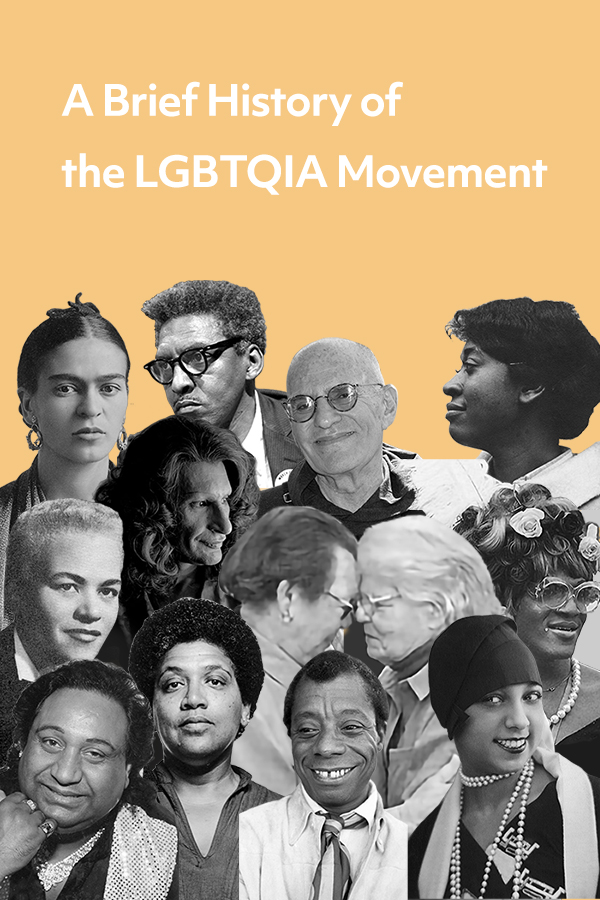

A brief summary of the history of the LGBTQIA+ movement

Olivia Pennelle (Liv) has a masters in clinical social work from Portland State University. She is a mental health therapist, writer, and human activist. Her writing has appeared in STAT News, Insider, Filter Magazine, Ravishly, The Temper, and Shondaland. She is the founder of Liv’s Recovery Kitchen, Life After 12-Step Recovery, and Tera Collaborations. She lives near Portland, Oregon. Follow her on Instagram @Livwritesrecovery and @teracollaborations

PrevThe Struggles LGBTQIA+ Community Faces in Recovery
Staying Sober When the Temperatures RiseNext

Any general advice posted on our blog, website, or app is for informational purposes only and is not intended to replace or substitute for any medical or other advice. Workit Health, Inc. and its affiliated professional entities make no representations or warranties and expressly disclaim any and all liability concerning any treatment, action by, or effect on any person following the general information offered or provided within or through the blog, website, or app. If you have specific concerns or a situation arises in which you require medical advice, you should consult with an appropriately trained and qualified medical services provider.

Top

Get the latest recovery news

Instagram Linkedin-in Facebook-f Youtube
  • Treatments
  • Opioids
  • Alcohol: Core Program
  • Alcohol: Flex Program
  • About Workit Health
  • Contact us
  • Our team
  • Media spotlight
  • Careers
  • We Accept Insurance
  • Check insurance
  • Aetna
  • Anthem of Ohio
  • Horizon BCBSNJ
  • Humana
  • Resources
  • What is harm reduction?
  • Addiction recovery resources
  • Suboxone FAQs
  • Blog
  • Friends and Family
  • Resources for friends and family
  • Help Them Heal Guide
  • Members
  • Login
  • Community
  • Request medical records
  • Tech support guides
  • Call us: 855-659-7734 M-F 8am-9pm EST
    • Partners
    • Make a referral
    • For health plans
    • For providers and hospitals
    • Third-party medical records requests
Read more about Suboxone risks and concerns

Suboxone (buprenorphine/naloxone) is indicated for the treatment of opioid dependence in adults. Suboxone should not be taken by individuals who have been shown to be hypersensitive to buprenorphine or naloxone as serious adverse reactions, including anaphylactic shock, have been reported. Taking Suboxone (buprenorphine/naloxone) with other opioid medicines, benzodiazepines, alcohol, or other central nervous system depressants can cause breathing problems that can lead to coma and death. Other side effects may include headaches, nausea, vomiting, constipation, insomnia, pain, increased sweating, sleepiness, dizziness, coordination problems, physical dependence or abuse, and liver problems. For more information about Suboxone (buprenorphine/naloxone) see Suboxone.com, the full Prescribing Information, and Medication Guide, or talk to your healthcare provider. You are encouraged to report negative side effects of drugs to the FDA. Visit www.fda.gov/medwatch or call 1-800-FDA-1088.

All clinical and medical services are provided by licensed physicians and clinicians who are practicing as employees or contractors of independently owned and operated professional medical practices that are owned by licensed physicians. These medical practices include Workit Health (MI), PLLC; Workit Health (CA), P.C.; Workit Health (NJ), LLC; Workit Health (OH), LLC; Virtual Physician Practice (NY), PLLC; and any other Workit Health professional entity that is established in the future.

Clinic locations

Arizona
9700 N. 91st. St.
Ste A-115
Scottsdale, AZ 85258
fax (HIPAA): (833) 664-5441

California
1460 Maria Lane
Ste 300
Walnut Creek, CA 94596
fax (HIPAA): (855) 716-4494

Florida
600 Heritage Dr.
Ste 210, #17
Jupiter, FL 33458
fax (HIPAA): (813) 200-2822

Illinois
1280 Iroquois Ave
Ste 402
Naperville, IL 60563
fax (HIPAA): (855) 716-4494

Michigan
3300 Washtenaw Ave
Ste 280
Ann Arbor, MI 48104
fax (HIPAA): (855) 716-4494

Montana
415 N Higgins Ave
Ste 6
Missoula, MT 59802
fax (HIPAA): (855) 716-4494

New Jersey
5 Greentree Center
Ste 117
Marlton, NJ 08053
fax (HIPAA): (609) 855-5027

New Mexico
5901 Indian School Road, NE
Ste 212
Albuquerque, NM 87110
fax (HIPAA): (855) 716-4494

Ohio
6855 Spring Valley Dr
Ste 110
Holland, OH 43528
fax (HIPAA): (513) 823-3247

Oklahoma
1010 24th Ave NW
Suite 100
Norman, OK 73069
fax (HIPAA): (855) 716-4494

Texas
5373 W Alabama St
Ste 204
Houston, TX 77056
fax (HIPAA): (737) 738-5046

Washington
9116 Gravelly Lake Dr SW
Ste 107 #3, PMB 1963
Lakewood, WA 98499-3148.
fax (HIPAA): (833) 328-1407

AICPA SOC

Terms of Service

Privacy Policy

Notice of Privacy Practice

View Accessibility Statement

© 2025 Workit Health. All rights reserved.

Your recovery, your way—
100% online

Book your appointment
Check your insurance coverage
  • Aetna
  • Humana
  • Horizon
  • Cigna
  • Blue Cross Blue Shield
  • and more

👉 Using insurance? Coverage checks are always for free in the Workit Health app.

Check your coverage

Not ready to start? We'll send you more information:

  • *Messaging frequency varies. I can unsubscribe at any time.

    **Messaging frequency varies. Message and data rates may apply. I can opt out at any time by replying STOP. I can reply HELP to receive support. If I do not consent to receive SMS, and Workit Health is unable to reach me by email, I understand that they will not be able to contact me by text.

    View our Privacy Policy, Terms of Service, and Consent to SMS and Email.

  • Should be Empty:

This site uses cookies to improve your experience. By using this site, you consent to our use of cookies.

Accept Cookies